Acupuncture for Back Pain II

The neat thing about treating low back pain with Acupuncture is that it benefits the body in many more ways than just alleviating pain. The adrenals, the power pack of the hormone system, are ‘ad-renals as they sit on top of the kidneys, and together these joined organs ‘govern’ the back, according to Chinese Medicine theory. So when the adrenals become run down from stress and agitation, they directly affect the nerves of the back, making it susceptible to stiffness and pain. This explains how so many people suddenly throw their back out with no exertion or instigation.

The low back is a vulnerable spot where our two bendable upper and lower halves are linked solely by the narrow spine and its adjoining muscles & fascia. This area gets both overworked and under used. The muscles become board-like and lose their flexibility, just like a new supple garden hose that eventually becomes brittle and easily cracked from oxidation.

When I treat the back, I address the muscles and the electrical conduits that run its entire length. So I start with a vibrating massage tool to relax the body from head to toe to “wake it up” and get all the cells vibrating. The patient LOVES this part and can sink into a relaxed state of “letting go.” The infra-red heat lamp gives luxuriant heat to the area and helps break up inflammation. Painless, fine needles are inserted so quickly that, in most cases, the brain does not have time to register any sensation at all. The heat from  a moxa stick or the lamp penetrates the tissue and is also conducted down the shaft of the needle to reach the core of the tight muscle or the pinched nerve. It can flow into the joints, deep into the thickest part of the buttock, addressing the sciatic nerve and any inflammatory arthritis in the hip joint. The heat and the electric effect of the needle cause the muscle fibers to relax around the nerve, discharge the built-up charge, and turn off the pain nerves. The increased circulation brings in nutrients and carries away toxins.After forty years of getting better and better at this, I feel bad for so many who still bear it in silence, allowing the condition to worsen while suffering from the accumulating side effects of pain meds.  One patient was on 10 Vicodin a day after 2 surgeries. He was screaming as he maneuvered his walker into my waiting room. After 2 treatments he was almost pain free. I love those stories…! Please comment here on the blog and share Your views or stories!! I would love to hear…

Share this:

The Brain Body Bliss Podcast

I invite medical professionals, healers, and patients to share their experiences. Here we focus on ancient and modern mental and emotional spiritual healing and practical self-help methods for ongoing health.

Acupuncture for Back Pain

Let us look at Acupuncture for back pain—the pandemic in our society among stressed sedentary workers who overdo on weekends. So many people depend on NSAIDs “band aid” pain meds with deleterious effects even when easy alternatives exist. The great thing about treating low back pain with Acupuncture is that the treatment will benefit internal organs while alleviating pain. Certain trigger points for pain are also activating points for intestines, kidneys, and bladder. The adrenals—the power pack of the hormone system, are ‘ad-renals’ as they sit on top of the kidneys. Together these joined organs ‘govern’ the back, according to Chinese Medicine theory. So when the adrenals become run down from stress and agitation, they directly affect the nerves of the back, making it susceptible to stiffness and pain. This explains why so many people will suddenly throw their back out with no causal exertion or injury.

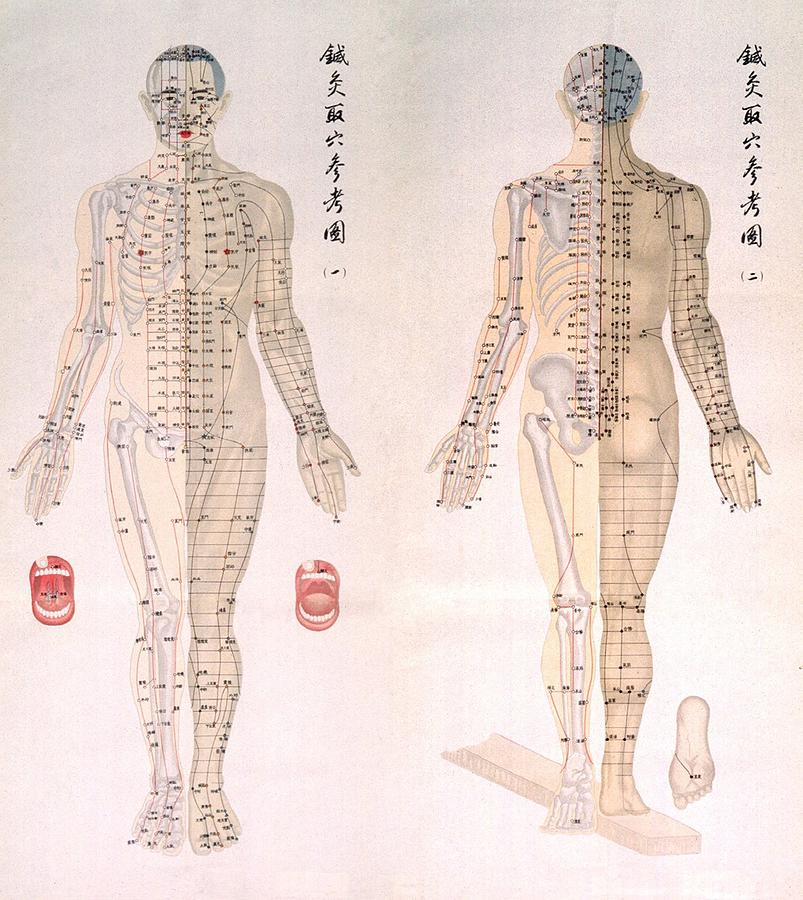
When I treat the back, I address the muscles and the electrical conduits that run its entire length.  There are points along the Bladder Meridian running down the leg that pull low back congestion down and away. So I start with a vibrating massage tool to relax the body from head to toe to “wake it up”, relaxing the entire nervous system, and getting all the cells vibrating. The patient LOVES this part and can sink into a relaxed state of “letting go.” The infra-red heat lamp gives luxuriant heat to the area and helps break up inflammation.

Painless, fine needles are inserted so quickly that, in most cases, the brain does not have time to register any sensation at all. The heat from a moxa stick or the infrared lamp penetrates the tissue and is also conducted down the shaft of the needle to reach the core of the tight muscle or the pinched nerve. It can flow into the joints, deep into the thickest part of the buttock, addressing the sciatic nerve and any inflammatory arthritis in the hip joint. The heat and the electrical effect of the needle cause the muscle fibers to relax around the nerve, discharge the built-up charge, and turn off the pain nerves. The increased circulation brings in nutrients and carries away toxins. And the overall treatment induces the feel-good endorphins all through the body and mind…

If only people realized that they could alleviate their back pain AND balance and rejuvenate their internal organs at the same time. Then they would get it that this kind of treatment achieves much more as a ‘5,000 mile tune-up,’ and is worth pursuing.  After forty years of watching miracles happen, I feel bad for so many who still bear it in silence, allowing the condition to worsen while suffering from the accumulating side effects of pain meds.

One patient was on 10 Vicodin a day after 2 surgeries, was screaming as he maneuvered his walker into my waiting room. After 2 treatments he was almost pain free, and then okay ever after. I love those stories…! Please post your comments here on the blog in the box below and share Your views or stories!! I would love to hear…

Dr. Mercola: Acupuncture & More Natural Solutions for Pain

What is Acupuncture?

Acupuncture is an ancient Chinese medical practice with roots that go back thousands of years. According to the Eastern mindset, your body is a cohesive unit, or whole – a complex system where everything within it is inter-connected, and where each part affects all other parts. A major component is the acceptance of an invisible flow of chi (or ki). This chi can be translated as “energy” or “life force,” which circulates through meridians in your body. When energetic blocks or deficiencies occur within a meridian, an imbalance is created that can cause a ripple effect of physical symptoms. Needles inserted into certain points along the meridians can stimulate sluggish chi, disperse blocks, or otherwise manipulate the flow of energy.

In essence, lack of balance within this bio-energetic system – which also includes blood flow and nutrients – is the precursor to all illness. Your body exhibits symptoms when suffering from inner disease and if it is not rebalanced, these symptoms may lead to acute or chronic illnesses of all kinds.

Chinese medicine, contrary to Western allopathic medicine, does not treat symptoms, but rather seeks to find the origin of the imbalance that produced the symptoms in the first place. Another major difference is that acupuncture, which is part of Traditional Chinese Medicine (TCM), is remarkably safe with few, if any, negative side effects, so it certainly doesn’t hurt to try.

Traditionally, acupuncture is used to treat all kinds of health problems. In many Asian cultures, you see an acupuncturist in the same way you’d see a primary care physician here in the West, and in someUSstates acupuncturists are in fact considered primary health care physicians. Still, many Westerners have been slow to grasp this type of holistic view, where your body is perceived as being perfectly capable of self-correction and healing without drug intervention. Scientists are still at a loss to explain why acupuncture works, but for those who get relief or healing, the mechanics may not be of great importance.

Other Alternative Pain Treatments

Besides acupuncture, there are a number of treatment modalities that can help ease pain, such as:

  • Emotional Freedom Technique (EFT): Few people want to be told that their pain is psychological or emotional in origin, but there’s quite a bit of evidence that backs this up. Underlying emotional issues and unresolved trauma can have a massive influence on your health, particularly as it relates to physical pain. According to Dr. John Sarno, a psychiatrist who uses mind-body techniques to treat patients with severe low back pain, EFT has a greater than 80 percent success rate
  • Chiropractic adjustments: According to a recent study published in theAnnals of Internal Medicine5 and funded by the National Institutes of Health, patients with neck pain who used a chiropractor and/or exercise were more than twice as likely to be pain free in 12 weeks compared to those who took medication
  • Massage: Massage releases endorphins, which help induce relaxation, relieve pain, and reduce levels of stress chemicals such as cortisol and noradrenaline – reversing the damaging effects of stress by slowing heart rate, respiration and metabolism and lowering raised blood pressure. It is a particularly effective therapy for stress-related tension, which experts believe accounts for as much as 80 to 90 percent of disease
  • Neuro-Structural Integration Technique (NST): NST is a gentle, non-invasive technique that stimulates your body’s reflexes, which can provide relief for back pain. Simple movements are done across muscles, nerves and connective tissue, which helps your neuromuscular system to reset all related tension levels, promoting natural healing. The results can be both profound and lasting, and are usually apparent within two or three sessions.

If you have chronic pain of any kind, please understand that there are many safe and effective alternatives to prescription and over-the-counter painkillers, though they may require some patience. Among the best are:

  • Start taking a high-quality, animal-based omega-3 fat like krill oil. Omega-3 fats are precursors to mediators of inflammation called prostaglandins. (In fact, that is how anti-inflammatory painkillers work, they positively influence prostaglandins.) The omega-3 fats EPA and DHA contained in krill oil have also been found in many animal and clinical studies to have anti-inflammatory properties.
  • Reduce your intake of most processed foods as not only do they contain sugar and additives but most are loaded with omega-6 fats that upset your delicate omega 3-6 ratio, which will contribute to inflammation.
  • Eliminate or radically reduce most grains and sugars (especially fructose) from your diet. Avoiding grains and sugars will lower your insulin and leptin levels. Elevated insulin and leptin levels are one of the most profound stimulators of inflammatory prostaglandin production. That is why eliminating sugar and grains is so important to controlling your pain.
  • Optimize your production of vitamin D by getting regular, appropriate sun exposure, which will work through a variety of different mechanisms to reduce your pain.

Dr. Mercola: Acupuncture and Chronic Pain

I am happy to pass on this article by Dr. Mercola about Acupuncture and Chronic Pain. It includes a study, an overview, and other alternative measures for pain.  Please comment below with your much welcomed feedback and…Enjoy!

Acupuncture Confirmed Helpful for Chronic Pain

September 29 2012 | 5,880 views | + Add to Favorites
100043 EmailPrint

By Dr. Mercola

Chronic pain is an exceedingly common condition impacting an estimated 76.5 million Americans, one-third of whom describe their pain as severe and “disabling.” When it comes to treating ailments such as chronic pain, I definitely prefer non-toxic options to modern medicine’s poor excuses for “cures.”

One such option is acupuncture, which can be an effective option for a number of health problems, but pain in particular.

In a recent analysis published in the Archives of Internal Medicine,1 researchers concluded that acupuncture has a definite effect in reducing chronic pain, such as back pain and headaches – more so than standard pain treatment. Real acupuncture also produced slightly better results than using sham needles, which suggests the benefits of needling are due to more than the placebo effect.

According to Timemagazine:2

“The findings counter those of the last large study on the subject, which found that the needle technique was no better than a fake acupuncture treatment – using random pricking with toothpicks – in reducing people’s pain. But Vickers says his meta-analysis of the data, in which researchers reviewed 29 previous studies involving 17,922 participants, does a few things the previous studies did not.

For one, he and his colleagues began by looking at only the most rigorous trials involving acupuncture and pain relief – those that directly compared acupuncture treatment with some type of sham needle therapy in which needles were either inserted only superficially or placed in locations that are not known by acupuncture standards to be key treatment points in the body.

The authors of the analysis contacted each of the researchers on the previous studies to discuss with them how they separated the two treatment groups. By limiting their review to the most robust studies published, the authors could assess with more confidence acupuncture’s true effect on participants’ reports of pain before and after treatment.”

Clear and Robust Effects of Acupuncture

The researchers also went the extra mile by retrieving the raw data on self-reported pain. By standardizing the various study participants’ responses, they were able to more accurately assess and compare them as a whole. The team discovered a “clear and robust” effect of acupuncture in the treatment of:

  • Back pain
  • Neck pain
  • Shoulder pain
  • Osteoarthritis
  • Headaches

On a scale of 0 to 100, participants who started out with a pain rating of 60 experienced an average 30 point drop (a 50 percent reduction) in response to the real acupuncture treatments (using needles); a 25 point drop when receiving sham acupuncture; and a mere 17 point drop when receiving “standard pain care” that did not include acupuncture. According to the lead author:3

“The effects of acupuncture are statistically significant and different from those of sham or placebo treatments… So we conclude that the effects aren’t due merely to the placebo effect.”

Furthermore, as reported by HealthDay:4

“The authors stressed that although the superiority of true acupuncture over sham acupuncture appeared to be relatively small, the real-world choice patients face is not between acupuncture or fake acupuncture but rather between acupuncture or no acupuncture at all. And in that context they suggested that their findings are ‘of major importance for clinical practice.’

‘Basically what we see here is that the pain relief difference from acupuncture versus no acupuncture is notable, and important, and difficult to ignore,’ [lead author] Vickers said.”